
Call: 08045802973
 Send Inquiry
 Send Inquiry
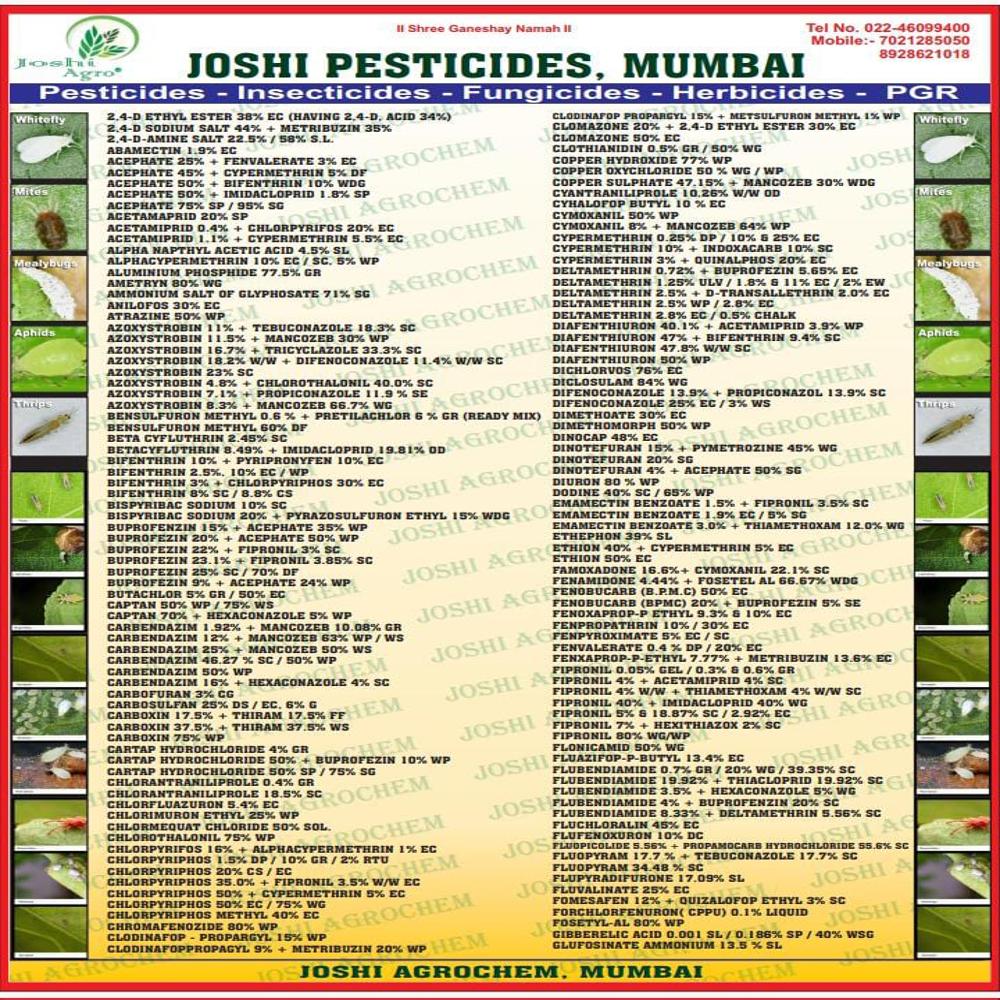
Penoxsulam 1.02% + Cyhalofop-butyl 5.1% OD
MOQ : 25 Kilograms
Penoxsulam 1.02% + Cyhalofop-butyl 5.1% OD Specification
- Purity(%)
- Penoxsulam 1.02%, Cyhalofop-butyl 5.1%
- Moisture (%)
- 0.5%
- Ph Level
- 5.5-7.5
- Ash %
- 0.2%
- Water Content Vol%
- Not more than 0.5%
- Classification
- Insecticide
- Grade
- Agricultural Grade
- Smell
- Characteristic
- Active Ingredient
- Penoxsulam 1.02% w/w + Cyhalofop-butyl 5.1% w/w
- Appearance
- Clear to slightly hazy liquid
- Place of Origin
- India
- Density
- 1.06 Gram per cubic centimeter(g/cm3)
- Melting Point
- Penoxsulam: 146-149C, Cyhalofop-butyl: 81-83C
- Molecular Formula
- C16H14F3N5O5S (Penoxsulam), C20H20FNO4 (Cyhalofop-butyl)
- Shape
- Liquid
- State
- Liquid
- Properties
- Selective, post-emergence herbicide formulation for paddy fields
- EINECS No
- - (Penoxsulam), 602-525-8 (Cyhalofop-butyl)
- Proportional Valve
- As per label/manual instructions
- CAS No
- 219714-96-2 (Penoxsulam), 122008-85-9 (Cyhalofop-butyl)
- Product Name
- Penoxsulam 1.02% + Cyhalofop-butyl 5.1% OD SE
- Color
- Light yellow to brown
- Packing Size
- 100 mL, 250 mL, 500 mL, 1 Litre
- Target Weeds
- Control of broad-leaved weeds, sedges, and grasses in rice
- Recommended Dosage
- Use as per local agricultural extension recommendation or label
- Storage Condition
- Store in a cool, dry place, away from direct sunlight
- Application
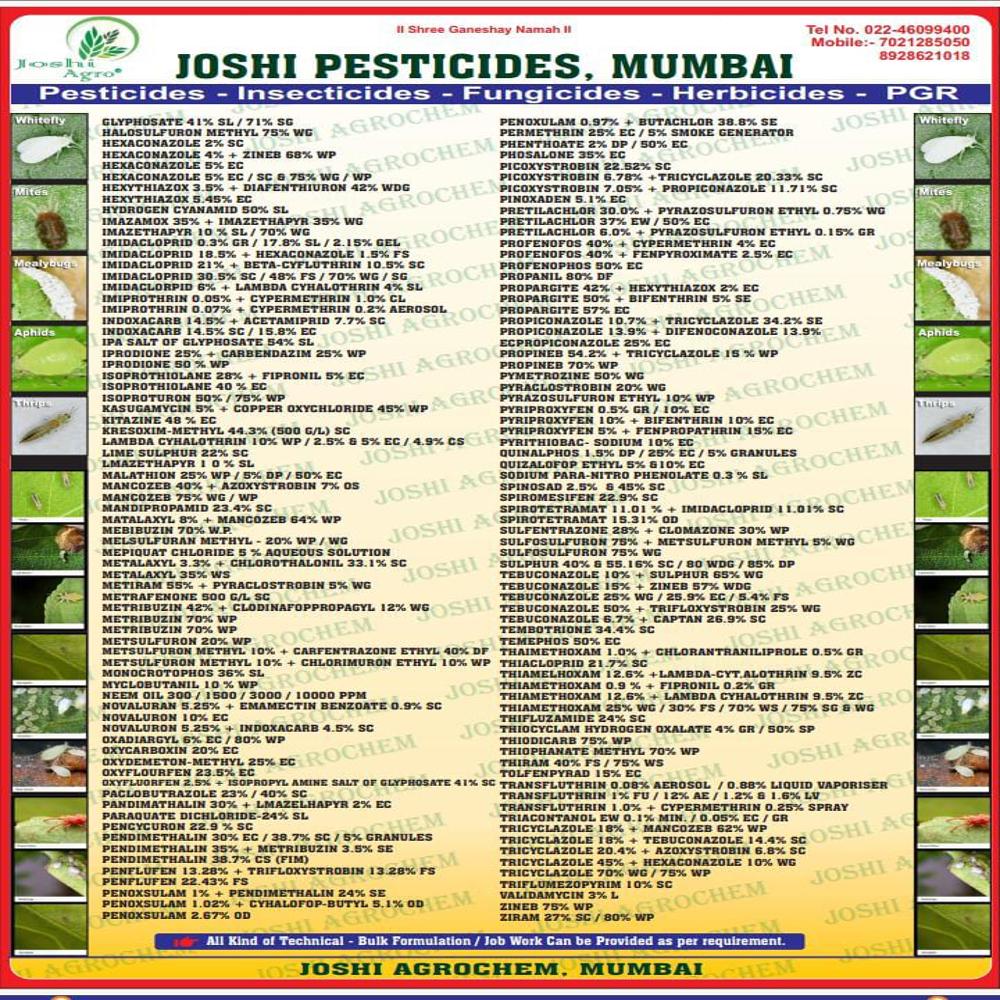
- Used as a post-emergence herbicide in transplanted and direct-seeded rice
- Toxicological Information
- Low mammalian toxicity when used according to label guidelines
- Shelf Life
- 2 years from the date of manufacture
- Formulation Type
- Oil Dispersion (OD)
- Compatibility
- Compatible with other commonly used rice herbicides
Penoxsulam 1.02% + Cyhalofop-butyl 5.1% OD Trade Information
- Minimum Order Quantity
- 25 Kilograms
- Delivery Time
- 1 Week
About Penoxsulam 1.02% + Cyhalofop-butyl 5.1% OD
Penoxsulam 1.02% + Cyhalofop-butyl 5.1% OD (Oil Dispersion) is a selective, broad-spectrum, post-emergence herbicide primarily used in rice cultivation (both transplanted and direct-seeded) to control a wide range of weeds, including grasses, sedges, and broadleaf weeds. The combination features a dual mode of action, providing effective control against tough weeds like Barnyard grass (Echinochloa spp.) and Sedges (Cyperus spp.).Key Agricultural and Pesticide Benefits:
- Broad-Spectrum Weed Control: The combination of Penoxsulam (ALS inhibitor) and Cyhalofop-butyl (ACCase inhibitor) acts systemically to control narrow-leaf weeds, sedges, and broadleaf weeds simultaneously, covering the three major categories of weeds in paddy fields.
- Advanced OD Formulation: The Oil Dispersion (OD) formulation enhances the solubility and absorption of the active ingredients into the plant, leading to improved efficacy, better leaf coverage, and excellent rainfastness.
- Effective Resistance Management: Using two different modes of action (ALS and ACCase) reduces the risk of herbicide resistance developing in weeds compared to single-ingredient products.
- High Crop Safety: It is highly selective for rice crops and safe to use in both transplanted and direct-seeded rice (DSR) when applied at the recommended stage.
- Improved Yield and Quality: By significantly reducing weed density and competition, the herbicide promotes healthier crop growth, resulting in higher tiller production and better grain yield.
- Operational Efficiency: As a pre-mixed, post-emergence solution, it reduces the need for costly manual weeding and eliminates the need for tank-mixing different herbicides.
Targeted Weeds and Application Timing:
- Target Weeds: Effective against Echinochloa colona, Echinochloa crusgalli (Barnyard grass), Leptochloa chinensis, Cyperus difformis, Cyperus iria, and Caesulia axillaris.
- Optimal Timing: Best applied 1520 days after transplanting (DAT) or sowing, generally when weeds are at the 3-5 leaf stage.
Superior Weed Control for Rice Farmers
With its unique combination of Penoxsulam and Cyhalofop-butyl, this herbicide effectively eliminates broad-leaved weeds, sedges, and grasses that commonly affect rice crops. Its selective mode of action ensures rice plants remain unharmed while weeds are efficiently managed post-emergence, leading to healthier, higher-yielding fields.
Convenient and Compatible Formulation
Formulated as an oil dispersion, this herbicide offers excellent mixing capabilities with other commonly used rice herbicides, enhancing its utility in integrated weed management strategies. The product's density and shelf stability, combined with clear to slightly hazy appearance, make application straightforward for farmers.
Safe Storage and Low Toxicity Profile
The herbicide maintains a low mammalian toxicity profile when used as directed, making it safer for handlers and the environment. It should be stored in a cool, dry place, away from direct sunlight, ensuring optimal efficacy and long shelf life for two years from the date of manufacture.
FAQ's of Penoxsulam 1.02% + Cyhalofop-butyl 5.1% OD:
Q: How should Penoxsulam 1.02% + Cyhalofop-butyl 5.1% OD be applied to rice fields?
A: This herbicide is used as a post-emergence treatment in both transplanted and direct-seeded rice. It should be applied according to local agricultural extension recommendations or as specified on the label, ensuring uniform coverage across the target area.Q: What types of weeds does this herbicide target in paddy cultivation?
A: Penoxsulam 1.02% + Cyhalofop-butyl 5.1% OD is specifically designed to control broad-leaved weeds, sedges, and grasses, which are common problems in rice paddies.Q: When is the ideal time to use Penoxsulam + Cyhalofop-butyl OD in the rice crop cycle?
A: The best time for application is post-emergence-after the rice and weed seedlings have emerged but before the weeds become too large and competitive. Refer to local guidelines for optimal timing.Q: Where should I store unused herbicide for maximum shelf life?
A: Store the product in its original, tightly closed container in a cool, dry place, away from direct sunlight. This ensures the effectiveness and safety of the product throughout its two-year shelf life.Q: What are the safety considerations when handling this herbicide?
A: The product is considered to have low mammalian toxicity when handled as instructed. Always follow label directions, wear protective gear during mixing and application, and avoid contact with skin and eyes.Q: Is Penoxsulam + Cyhalofop-butyl OD compatible with other herbicides?
A: Yes, the formulation is compatible with most commonly used rice herbicides, allowing for integrated weed management approaches without compromising efficacy.Q: What benefits can growers expect from using this product?
A: Rice farmers will experience effective control of a broad range of weeds, enhanced crop health, and improved yields since the formulation is selective and does not harm rice plants when applied properly.
Tell us about your requirement

Price:
Quantity
Select Unit
- 50
- 100
- 200
- 250
- 500
- 1000+
Additional detail
Mobile number
Email

More Products in Insecticides Pesticides Category
Cartap Hydrochloride 50% + Buprofezin 10% WP
Minimum Order Quantity : 25 Kilograms
Color : White to pale yellow
Melting Point : Decomposes on heating above 180C
Purity(%) : 98% (combined actives)
Ph Level : 6.08.0 (1% aqueous solution)
Grade : AGRICULTURE
Buprofezin 25% SC / 70% DF
Minimum Order Quantity : 25 Kilograms
Color : Pale yellow to yellowishbrown (SC), offwhite to light yellow (DF)
Melting Point : 104106C
Purity(%) : 98% (Technical), 25% SC, 70% DF
Ph Level : 6.08.0 (25% SC)
Grade : AGRICUTURE

Fipronil 4% + Acetamiprid 4% SC
Minimum Order Quantity : 25 Kilograms
Color : Offwhite to pale yellow
Melting Point : Not applicable (liquid formulation)
Purity(%) : 96%
Ph Level : 5.07.0 (at 1% aqueous solution)
Grade : agriculture
Chlorpyrifos + Cypermethrin
Color : Pale yellow
Melting Point : Not applicable (liquid formulation)
Purity(%) : 95% min (formulation dependent)
Ph Level : 5.0 7.0
Grade : Agricultural Grade

Contact Details
JOSHI AGROCHEM PHARMA PRIVATE LIMITED
GST : 27AAFCJ1227Q1Z8
- 813, Topiwala Center, Opp. Railway Station, Goregaon (West), Mumbai - 400062, Maharashtra, India
- Phone :08045802973
 Send Inquiry
- For Chemicals - Solvents :
Mobile. +918097911779
For Pharma - API's :
Mobile. +918655564472
For Agro - Pesticides :
Mobile. +918080701491
For Metals :
Mobile. +919322422799


Developed and Managed by Infocom Network Private Limited.
